Droven io ai automation in USA: The Complete 2026 Business Guide
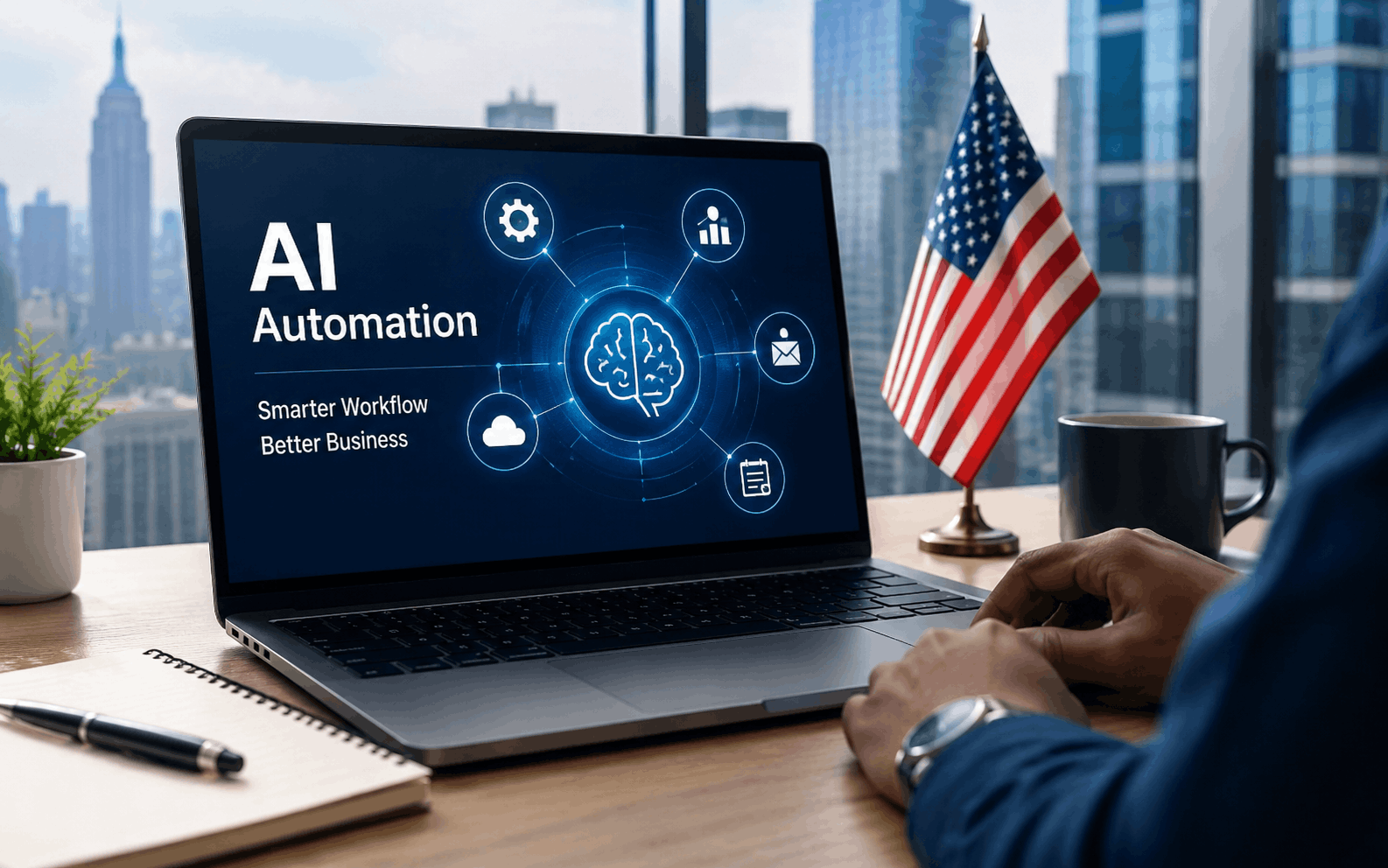
Droven.io is a vendor-neutral AI knowledge platform helping U.S. businesses navigate the complex landscape of AI automation tools. Covering everything from workflow automation and RPA to LLM-powered chatbots, Droven.io provides research-backed guidance that helps American companies identify, evaluate, and implement the right AI automation stack before spending a dollar on software.
According to the U.S. Census Bureau’s Business Trends and Outlook Survey (May 2026), overall AI usage among U.S. businesses now hovers between 17% and 20% — and that number is climbing fast. Among firms with 250 or more employees, 37% already use AI in their daily operations. The pressure to automate is real, and it’s intensifying.
The challenge most businesses face isn’t a lack of tools. It’s a lack of reliable, unbiased information about which tools actually work. That’s precisely the gap that droven io ai automation in usa coverage fills. Droven.io serves as an independent editorial platform that cuts through vendor marketing to help business owners make smarter, faster decisions about AI adoption.
This guide covers what Droven.io is, how it approaches AI automation, which tools it documents, and how U.S. businesses across industries are putting that knowledge to work. If you’re evaluating AI automation for the first time — or trying to make sense of a crowded market — this is your starting point.
What Is Droven.io and Why Does It Matter for U.S. Businesses?
Droven.io is not a software product. It’s an independent knowledge and editorial platform dedicated to artificial intelligence, automation, cloud computing, and digital transformation — with a specific focus on the U.S. market.
Think of it as a neutral advisor. Rather than pushing a specific tool, Droven.io publishes research-backed articles, guides, and trend analyses that help business owners, developers, and operational decision-makers understand what’s available before they commit budget. That vendor-neutral stance is increasingly rare and genuinely valuable in a market flooded with product-driven content.
The platform organizes its coverage across several core areas:
- Artificial Intelligence and Generative AI — covering large language models, AI-driven chatbots, and creative automation
- Digital Transformation — including AI business processes, big data and analytics, and automation/RPA
- Future of Work — examining how AI reshapes roles, workflows, and organizational design
- Information Technology — covering cloud infrastructure, managed IT, and cybersecurity
For American businesses facing labor shortages, rising operational costs, and increasing competition, droven io ai automation in usa content provides something practical: clarity. The platform simplifies technically complex topics so that non-technical executives can make informed decisions — without needing a computer science degree.
How Droven.io Approaches AI Automation Research
Droven.io’s editorial approach rests on three core pillars: automation, integration, and intelligence.
Automation coverage focuses on how systems learn from data patterns to handle repetitive, time-consuming tasks across departments — from HR screening to supply chain forecasting. Integration content examines how tools connect with existing software ecosystems, a critical consideration for any business that doesn’t want to rebuild its entire tech stack. Intelligence reporting goes deeper, exploring how AI-driven analytics and predictive modeling help companies do more than automate — they help businesses understand what’s happening and what’s coming next.
This structured approach makes Droven.io particularly useful for companies that are past the “should we use AI?” question and now wrestling with the harder one: “which tools, in which order, for which problems?”
The AI Automation Tools Documented by Droven.io
Droven.io’s coverage of droven io ai automation in usa spans the full spectrum of intelligent automation platforms currently in production across American businesses. Understanding the categories matters as much as knowing the individual tools.
Workflow Automation Platforms
These tools connect disparate business systems and trigger automated action sequences based on logic or AI-detected conditions. The most widely covered include:
- n8n — An open-source platform with 400+ native integrations and full code access, best suited for custom API-heavy workflows and high-volume deployments
- Make (formerly Integromat) — A visual, no-code builder with complex multi-branch logic, popular among agencies and SMBs
- Zapier AI — The most accessible entry point for non-technical teams, with natural language workflow creation built in
Conversational AI and LLM-Powered Systems
This category covers AI chatbots and voice agents built on large language models including GPT-4o, Claude, and Gemini. These systems handle customer interactions, lead qualification, and support automation at scale — and represent one of the fastest-growing segments in U.S. AI adoption.
A critical component Droven.io emphasizes here is Retrieval-Augmented Generation (RAG) — the approach that connects AI models to live business data (product catalogues, policy documents, CRM records) so they respond from your actual information rather than generic training data.
Robotic Process Automation (RPA)
RPA tools like UiPath and Automation Anywhere automate repetitive screen-level tasks: data entry, invoice processing, report generation. The RPA market alone reached $13.9 billion in 2025, according to Grand View Research, with financial services, healthcare, and e-commerce driving the majority of new deployments.
AI-Enhanced CRM Platforms
Tools like GoHighLevel, HubSpot AI, and Salesforce Einstein layer predictive analytics and automated follow-up sequences onto customer relationship management. For service businesses and agencies, GoHighLevel in particular consistently delivers some of the fastest automation ROI — typically within 45 to 60 days of deployment.
The State of AI Automation Adoption in the United States
The numbers paint a clear picture of where U.S. business AI adoption stands — and where it’s heading.
According to Grand View Research, the global AI automation market was valued at $129.9 billion in 2025 and is projected to reach $1,144.8 billion by 2033, growing at an 8.9% CAGR. MarketsandMarkets (2025) puts the trajectory even more aggressively, projecting $407 billion by 2027 at a 28.5% CAGR.
Adoption is accelerating across firm sizes. The U.S. Census Bureau’s BTOS data (December 2025 to May 2026) shows:
- 37% of firms with 250+ employees currently use AI in business operations
- 32% of firms with 100–249 employees report active AI use
- The Information sector leads at 39.7% AI adoption; Finance and Insurance follows at 33.9%
- Between 20% and 23% of all businesses expect to begin using AI within the next six months
According to Gartner (2025), 77% of enterprises in North America now use at least one AI-powered automation tool in production — up from 42% in 2023. That’s not a trend. That’s a structural shift.
The productivity gains are equally significant. McKinsey Global Institute (2025) reports that employees using AI automation tools see a 40% average increase in task throughput, with knowledge workers benefiting most in document processing, data extraction, and communication workflows. IBM’s Institute for Business Value (2025) found that businesses deploying AI workflow automation achieve 30–60% reductions in operational costs within automated process categories.
That context is exactly why droven io ai automation in usa coverage reaches the audience it does. Business owners don’t just want to know what AI automation can do in theory — they want verified data showing what it’s doing right now, in companies like theirs.
Real-World Industry Applications Covered by Droven.io
One of Droven.io’s strengths is its industry-specific coverage. AI automation isn’t a one-size-fits-all proposition, and the platform’s content reflects that.
Finance and Fintech
Droven.io covers AI applications in transaction monitoring, fraud detection, and portfolio optimization. In a sector where Finance and Insurance companies already show 33.9% AI adoption (Census Bureau, 2026), the demand for deeper automation guidance is substantial.
Healthcare
The platform documents how healthcare organizations use AI to streamline patient data management and support diagnostic analytics — two areas where accuracy and compliance make tool selection particularly high-stakes.
Retail and E-Commerce
AI-driven consumer behavior prediction and inventory planning are growing priorities for U.S. retailers. Droven.io’s coverage includes both the strategic case and the practical tools available for implementation.
Manufacturing and Supply Chain
Droven.io covers AI-powered demand forecasting and supply chain optimization — areas where platforms like Blue Yonder and RELEX Solutions are generating measurable efficiency gains for U.S. manufacturers.
Marketing and Content
From AI translation tools and image generators to SEO automation and campaign analytics, Droven.io’s marketing coverage is among its most active editorial areas. The platform also covers AI-driven personalization strategies — relevant given that 73% of businesses expect AI to improve their personalization capabilities by end of 2026, according to Salesforce.
How to Get Value from Droven.io as a U.S. Business
Using an educational platform effectively requires a method. Businesses that extract the most value from droven io ai automation in usa coverage tend to follow a consistent approach.
Start with your highest-cost manual process. Before reading about tools, identify the workflows in your business that consume the most time and carry the highest per-task cost. That’s your automation priority — not the most exciting use case, but the one with the clearest ROI baseline.
Use Droven.io’s coverage to shortlist, not finalize. The platform helps you understand the landscape and build a rational shortlist. Finalize your tool selection through hands-on trials and, where possible, implementation specialist input.
Cross-reference with compliance requirements. Droven.io follows responsible AI practices and references U.S. data privacy standards (GDPR and CCPA). For businesses in regulated industries, its coverage of ethical AI development is particularly relevant.
Revisit regularly. The AI automation landscape in 2026 moves fast. Droven.io publishes new guides and trend analyses continuously, and a tool that wasn’t viable six months ago may be the right answer today.
One practical benchmark from Forrester Research (2025): SMBs that deploy AI automation with specialist implementation support reach positive ROI in an average of 60–90 days. Those who self-deploy without structured knowledge inputs typically wait 6–12 months. The gap between informed and uninformed implementation decisions is measured in months of profit.
Common AI Automation Mistakes That Droven.io’s Research Helps Avoid
Gartner (2025) reports a striking statistic: 68% of failed AI automation projects fail not because of tool limitations, but due to poor integration architecture, inadequate knowledge base preparation, or missing escalation paths. The tool was rarely the problem. The decisions made before and during implementation were.
Droven.io’s coverage directly addresses these failure modes:
- Automating broken processes — the platform emphasizes mapping and improving workflows before automating them
- Choosing tools by brand recognition rather than fit — Droven.io’s vendor-neutral stance pushes readers toward requirements-first thinking
- Skipping analytics instrumentation — the platform consistently emphasizes measurement from deployment day one, not month three
- Ignoring data privacy regulations — U.S.-specific compliance content is woven throughout the automation coverage
Understanding these failure patterns before you start is what separates a 90-day ROI outcome from a 12-month disappointment.
Droven.io AI Automation in the USA: Where It’s Heading
The trajectory for both Droven.io’s coverage and U.S. AI automation adoption points in one direction. As AI pricing drops and accessibility increases — accelerated by cloud computing democratization — the gap between businesses that have automated and those that haven’t will widen at pace.
Droven.io’s editorial roadmap reflects the next wave: agentic AI systems that don’t just execute defined tasks but make decisions, adapt to new inputs, and manage multi-step processes autonomously. Coverage of machine learning, natural language processing, and data orchestration positions the platform to document these developments as they move from experimental to production.
For American businesses, the question is no longer whether AI automation belongs in your operations. It’s how quickly you can build the knowledge base to implement it well.
Start With Knowledge, Build With Confidence
The most expensive AI automation mistakes happen when businesses rush past the research phase. Droven io ai automation in usa content exists specifically to prevent that — giving decision-makers the vendor-neutral, research-backed foundation they need before committing to tools, contracts, or implementation timelines.
Visit droven.io to explore the full editorial library. Start with the AI automation and digital transformation categories, identify the articles most relevant to your industry, and build your implementation shortlist from an informed position.
The gap between businesses that automate intelligently and those that don’t is growing at 28.5% annually. Knowledge is where the advantage starts.
Frequently Asked Questions
What is Droven.io and what does it do for U.S. businesses?
Droven.io is an independent knowledge and editorial platform focused on AI, automation, cloud computing, and digital transformation for the U.S. market. It publishes vendor-neutral guides, tool analyses, and trend reports that help business owners and decision-makers evaluate AI automation options before investing. Droven.io does not sell software — it provides the research foundation that informs better technology decisions.
What AI automation tools does Droven.io cover?
Droven.io documents the full range of AI automation platforms currently used in U.S. business operations, including workflow automation tools (n8n, Make, Zapier AI), conversational AI systems (LLM-powered chatbots built on GPT-4o and Claude), RPA platforms (UiPath, Automation Anywhere), and AI-enhanced CRM tools (GoHighLevel, HubSpot AI, Salesforce Einstein).
How widely is AI automation adopted among U.S. businesses in 2026?
According to the U.S. Census Bureau’s Business Trends and Outlook Survey (May 2026), overall AI usage among U.S. businesses hovers between 17% and 20%. Among larger firms with 250 or more employees, 37% report active AI use. Gartner (2025) reports that 77% of North American enterprises now use at least one AI-powered automation tool in production.
How long does it take for AI automation to deliver ROI?
According to Forrester Research (2025), SMBs that deploy AI automation with specialist implementation support typically reach positive ROI within 60 to 90 days. Businesses that self-deploy without structured knowledge inputs average 6 to 12 months to reach the same outcome. The primary differentiator is implementation quality, not tool selection.
Is Droven.io suitable for small and mid-size businesses?
Yes. Droven.io’s content is designed to be accessible to businesses of all sizes, including startups and SMEs. The platform explains complex AI and automation concepts in clear, practical terms — and its coverage of scalable, cost-effective tools makes it directly relevant to businesses that don’t have enterprise-level implementation budgets.
What industries does Droven.io’s AI automation coverage focus on?
Droven.io covers AI automation applications across finance and fintech, healthcare, retail and e-commerce, manufacturing and supply chain, and marketing. Each industry section addresses sector-specific tools, compliance considerations, and use cases — rather than generic automation advice that doesn’t account for industry context.