Order Management AI Agent: Your Smartest New Hire
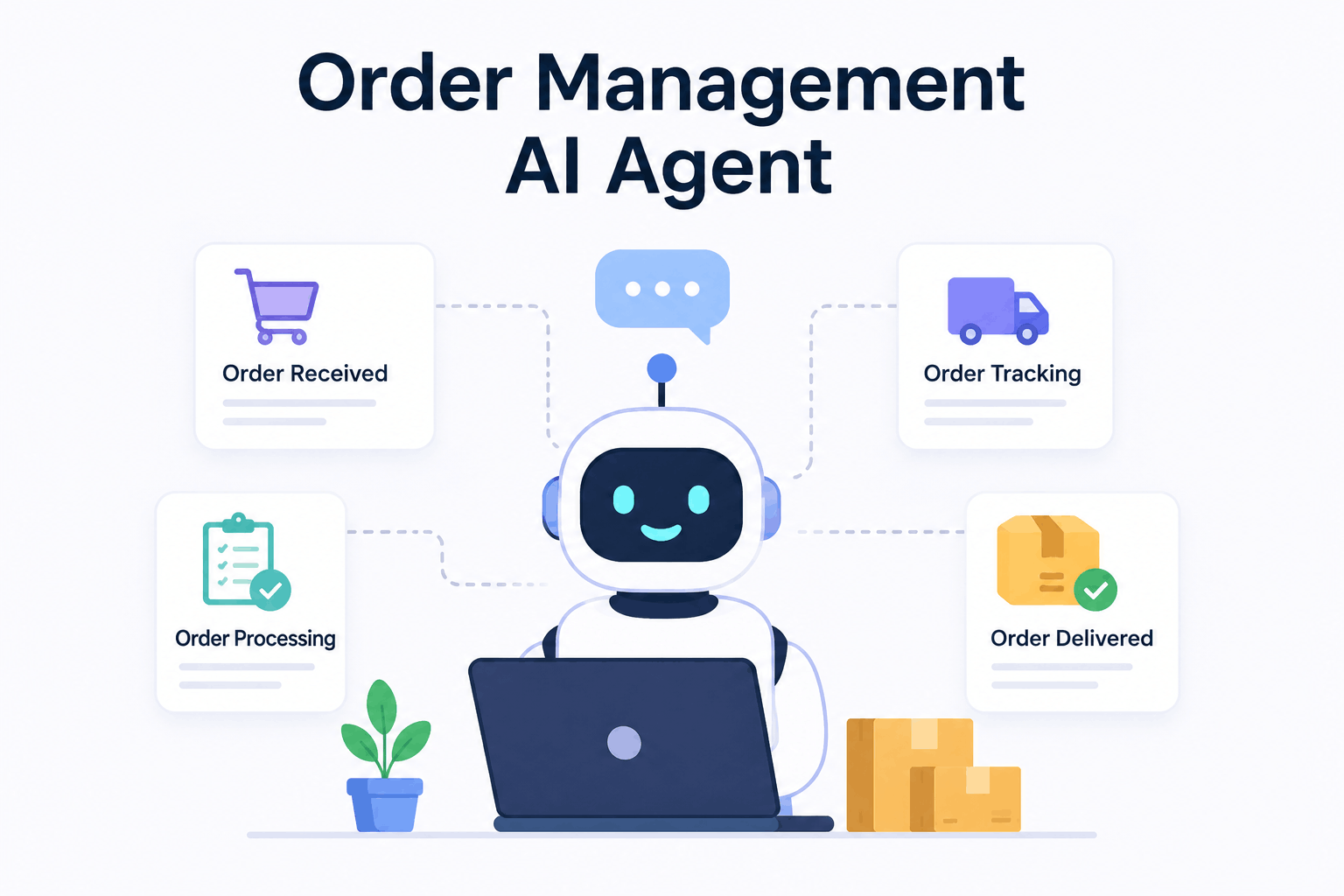
An order management AI agent is software that autonomously handles order processing tasks—tracking, routing, updating inventory, and resolving issues—without constant human input. It reduces errors, speeds up fulfillment, and frees your team to focus on growth rather than repetitive admin work.
Running an online business means juggling dozens of moving parts. Orders come in, inventory shifts, customers ask where their package is, and somewhere a shipment gets delayed. Handle this manually, and mistakes pile up fast.
That’s where an order management AI agent steps in. Think of it as a tireless team member that watches every order from checkout to delivery, makes decisions in real time, and flags problems before they reach your customers.
In this guide, you’ll learn what an order management AI agent does, how it works, the real benefits it delivers, and how to start using one in your own business.
What Is an Order Management AI Agent?
An order management AI agent is an autonomous software tool that manages the full order lifecycle. Unlike a basic automation script that follows fixed rules, an AI agent can reason, adapt, and act on its own to keep orders flowing smoothly.
It connects to your sales channels, warehouse systems, and shipping providers. Then it handles the busywork: confirming orders, checking stock, choosing the best fulfillment route, and updating customers along the way.
Here’s a simple analogy. A traditional system is like a vending machine—press a button, get a fixed result. An AI agent is more like a skilled operations manager who reads the situation, weighs options, and chooses the best action.
How does an order management AI agent differ from regular automation?
The key difference is decision-making ability. Standard automation follows “if this, then that” rules. An AI agent goes further:
- It interprets messy or incomplete data, like a mismatched shipping address.
- It prioritizes tasks, deciding which delayed order needs attention first.
- It learns from patterns, improving its responses over time.
This makes the agent useful for the unpredictable situations that break rigid rule-based systems.
How Does an Order Management AI Agent Work?
An order management AI agent works by connecting your tools, reading order data, and acting on it. Most modern agents are built on cloud-based software, which means they run online and scale with your order volume.
Here’s the typical workflow:
- Order capture: The agent pulls in new orders from your website, marketplaces, and apps.
- Validation: It checks payment status, stock levels, and shipping details for errors.
- Routing: It picks the best warehouse or supplier to fulfill the order quickly and cheaply.
- Tracking: It monitors the shipment and updates the customer automatically.
- Resolution: If something goes wrong—a stockout or carrier delay—it acts or alerts a human.
What technology powers these agents?
Most order management AI agents combine a few core technologies:
- Natural language processing (NLP): lets the agent read customer messages and product data.
- Machine learning helps it predict demand and spot unusual patterns.
- API integrations: connect the agent to your existing software as a service tools, payment gateways, and carriers.
Because many of these tools follow a subscription model, you can start small and expand as your needs grow. This fits well within a typical SaaS development process, where features roll out in stages.
Key Benefits of Using an Order Management AI Agent
Adopting an order management AI agent delivers measurable results. Here are the benefits that matter most to business owners.
1. Fewer costly errors
Manual order entry is a leading cause of fulfillment mistakes. A single wrong digit can send a package to the wrong city. According to research from IBM, poor data quality costs the US economy an estimated $3.1 trillion per year. An AI agent validates every order automatically, cutting human error dramatically.
2. Faster fulfillment
Speed wins customers. An AI agent processes orders in seconds, not hours. It picks the closest warehouse and the fastest carrier without anyone lifting a finger. Faster shipping leads to higher customer satisfaction and repeat purchases.
3. 24/7 operation
Your business doesn’t sleep, and neither does an AI agent. Orders placed at 2 a.m. get processed instantly. This round-the-clock coverage is especially valuable for stores selling across time zones.
4. Lower operating costs
By automating repetitive tasks, you reduce the need for a large operations team. Staff can shift to higher-value work like supplier relationships and customer experience. The savings compound as your order volume grows.
5. Smarter inventory management
An order management AI agent watches stock levels in real time. It can predict when you’ll run low and trigger reorders before you sell out. This prevents both stockouts and overstocking, which tie up cash.
Real-World Use Cases for an Order Management AI Agent
Knowing the benefits is helpful, but seeing the agent in action makes it click. Here are common scenarios where an order management AI agent earns its keep.
E-commerce and retail
An online clothing brand sells across its website, Amazon, and Instagram. Orders flood in from all three. The AI agent centralizes every order in one place, checks stock, and routes each to the nearest fulfillment center. No double-selling, no overselling.
Subscription box services
Subscription businesses ship on tight schedules. An AI agent tracks renewal dates, confirms each subscriber’s stock is reserved, and flags any payment failures early. This keeps the subscription model running without manual chasing.
Wholesale and B2B
B2B orders are often large and complex, with custom pricing and bulk quantities. An order management AI agent applies the right pricing rules, checks credit terms, and splits shipments when needed. It handles complexity that would overwhelm a spreadsheet.
Multi-warehouse operations
For businesses with several warehouses, choosing where to fulfill from is a constant puzzle. The agent solves it instantly by weighing distance, stock, and shipping cost—delivering orders faster and cheaper.
How to Choose and Implement an Order Management AI Agent
Picking the right tool matters. A poor fit creates more work, not less. Here’s how to choose and roll out an order management AI agent the smart way.
Step 1: Define your needs
Start by listing your biggest order pain points. Are you drowning in returns? Struggling with stockouts? Spending hours on manual data entry? Your problems should guide your choice, not flashy features.
Step 2: Check integrations
Your agent must connect to the tools you already use—your store platform, payment processor, and shipping carriers. Look for an agent with strong API integrations. If it doesn’t connect cleanly, it won’t save you time.
Step 3: Start with an MVP approach
You don’t need every feature on day one. Borrow a lesson from agile development: launch a minimum viable product (MVP) version that handles your core workflow, then expand. This lowers risk and helps your team adjust gradually. [Link to internal guide on MVP strategy]
Step 4: Test before scaling
Run the agent on a small batch of orders first. Watch how it handles edge cases like cancellations or address errors. Trust is earned through testing, not promises.
Step 5: Plan your product roadmap
As you grow, your needs change. Choose a vendor with a clear product roadmap so the tool keeps improving alongside your business. A flexible SaaS architecture ensures the agent can scale with rising order volume. [Link to internal resource on choosing SaaS vendors]
Decision criteria: who needs one most?
- Choose an order management AI agent if you process more than a few hundred orders a month and sell across multiple channels.
- Wait if you’re a very small store with simple, single-channel sales—basic automation may be enough for now.
- Prioritize advanced AI features if your orders are complex, high-volume, or span several warehouses.
The Future of Order Management
Order management is moving from reactive to predictive. Tomorrow’s agents won’t just process orders—they’ll forecast demand, prevent delays, and optimize your entire supply chain before issues arise.
As more businesses adopt these tools, an order management AI agent will shift from a competitive edge to a basic expectation. Customers will demand the speed and accuracy that only automation can deliver consistently.
The good news? You don’t need to wait. The technology is ready today, and the SaaS development process behind these agents keeps making them easier and cheaper to adopt.
Ready to Automate Your Order Management?
An order management AI agent is one of the highest-impact tools you can add to a growing business. It cuts errors, speeds up fulfillment, runs around the clock, and frees your team to focus on what humans do best.
Start by mapping your biggest order headaches, then look for an agent that integrates with your stack and grows with you. Begin small, test thoroughly, and scale with confidence.
Ready to take the next step? [Explore our order management solutions] or [book a free demo] to see an AI agent in action.
Frequently Asked Questions
What is an order management AI agent?
An order management AI agent is autonomous software that handles the full order lifecycle—from capture and validation to routing, tracking, and issue resolution—without constant human oversight. It makes real-time decisions to keep orders flowing smoothly.
How much does an order management AI agent cost?
Most tools use a subscription model, with pricing based on order volume or features. Entry plans can start under $100 per month, while enterprise solutions cost more. Starting with an MVP-style plan keeps initial costs low while you test the value.
Can an order management AI agent integrate with my existing tools?
Yes. Quality agents offer API integrations that connect to popular store platforms, payment gateways, and shipping carriers. Always confirm compatibility with your specific tech stack before committing.
Is an order management AI agent suitable for small businesses?
It depends on your volume. If you process a few hundred orders a month across multiple channels, an AI agent saves real time. Very small, single-channel stores may find basic automation sufficient for now.
How long does it take to implement an order management AI agent?
Timelines vary by complexity. A simple setup with strong integrations can go live in days, while custom, multi-warehouse deployments may take several weeks. Using an agile development approach—starting small and scaling—speeds up adoption.
Will an order management AI agent replace my team?
No. The agent handles repetitive tasks like data entry and tracking, freeing your team to focus on higher-value work such as supplier relationships, customer experience, and growth strategy.