Leading AI Agents for Security Questionnaire in 2026
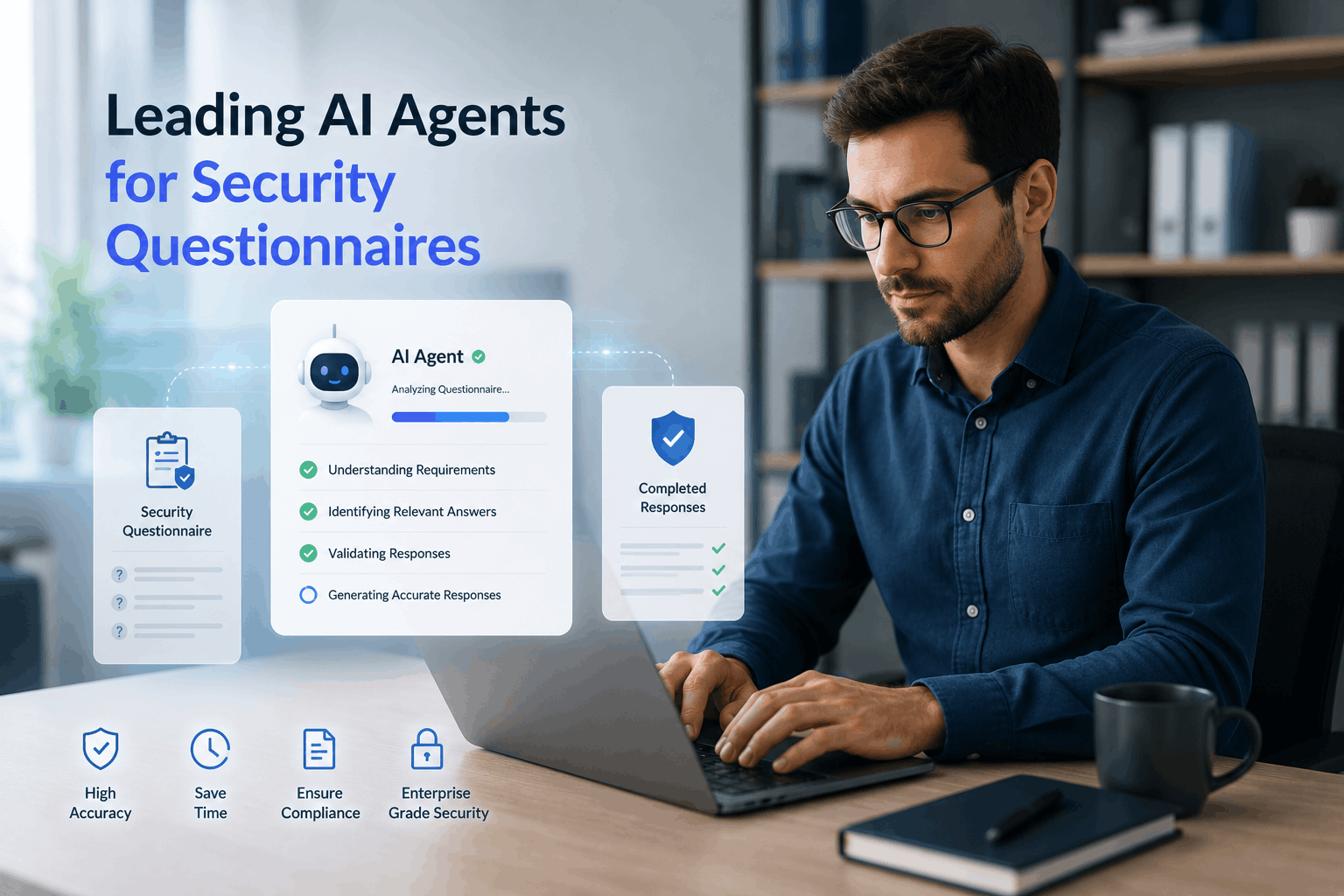
Leading AI agents for security questionnaire automate the time-consuming process of completing vendor risk assessments by using machine learning to analyze, match, and populate answers from a company’s existing documentation. Top platforms include Conveyor, Vanta, Responsive (formerly RFPIO), Sprinto, and Drata—each offering distinct features depending on company size and compliance needs.
Security questionnaires are one of the most universally dreaded tasks in enterprise sales. A potential customer sends over a 200-question spreadsheet asking about your data encryption standards, access control policies, and incident response procedures. Your sales cycle grinds to a halt. Your security team scrambles.
The problem isn’t just the volume of questions—it’s the repetition. Most vendors receive dozens of these questionnaires per year, and roughly 70–80% of the questions overlap across assessments. Companies waste thousands of hours answering the same questions in slightly different formats, often pulling answers manually from outdated documentation.
That’s where leading AI agents for security questionnaire automation come in. These platforms use machine learning, natural language processing, and knowledge base management to dramatically reduce the time it takes to complete vendor risk assessments. Instead of starting from scratch, AI agents analyze incoming questions, match them against pre-approved answers, and auto-populate responses—cutting completion time by up to 90% in some cases.
This post breaks down what AI security questionnaire agents actually do, which platforms lead the market in 2026, and how to choose the right one for your organization.
What Does an AI Agent for Security Questionnaires Actually Do?
Before comparing tools, it helps to understand the core mechanics. AI agents for security questionnaire automation aren’t just glorified search tools—they’re intelligent systems that learn from your documentation and improve over time.
How AI-Powered Questionnaire Automation Works
Most leading platforms follow a similar workflow:
- Ingest your knowledge base — The AI imports your existing security documentation: SOC 2 reports, ISO 27001 certificates, privacy policies, past questionnaire responses, and internal policies.
- Analyze incoming questions — When a new questionnaire arrives (usually as a spreadsheet or web form), the AI reads each question and maps it to the most relevant knowledge base entries.
- Auto-populate answers — The AI drafts responses using pre-approved language, flagging low-confidence answers for human review.
- Learn from edits — When your security team modifies an AI-generated response, the platform updates its model to produce better answers in future questionnaires.
The result: what used to take a security analyst two weeks now takes a few hours of review. According to Gartner, vendor risk management is one of the top three operational burdens for enterprise IT and security teams—making automation in this area a high-ROI investment.
The Leading AI Agents for Security Questionnaire Automation in 2026
The market has matured considerably over the past three years. Here are the platforms consistently recognized as leaders.
Conveyor — Best for Mid-Market SaaS Companies
Conveyor is purpose-built for SaaS vendors that deal with high volumes of customer security reviews. Its AI agent scans incoming questionnaires and automatically generates responses using a centralized trust center and knowledge base.
Key capabilities include:
- AI-assisted auto-fill with confidence scoring
- A public-facing trust portal where customers can self-serve common security documents
- Integration with Salesforce and HubSpot to connect questionnaire status with deal pipelines
- Automated follow-ups that reduce back-and-forth between vendors and buyers
Conveyor’s trust center approach is particularly effective because it reduces inbound questionnaires altogether—customers can access your security posture documentation directly, without sending a formal assessment. For mid-market companies processing 50–200 questionnaires per year, this dual approach significantly reduces the operational burden.
Vanta — Best for Compliance-Led Organizations
Vanta is primarily known as a compliance automation platform, but its questionnaire automation capabilities have become a standout feature. Because Vanta continuously monitors your infrastructure for compliance evidence, it can pull real-time, accurate answers into questionnaire responses—rather than relying on static documentation that may be outdated.
This matters. One of the biggest risks with AI-generated questionnaire answers is accuracy drift: your policies change, but your knowledge base doesn’t keep up. Vanta addresses this by tying responses directly to live compliance data.
Vanta supports major frameworks including SOC 2, ISO 27001, HIPAA, GDPR, and PCI DSS. For organizations already using Vanta for compliance, the questionnaire automation feature adds immediate value at no additional workflow cost.
Responsive (formerly RFPIO) — Best for Enterprise Scale
Responsive is one of the oldest and most established players in the response management space. Originally built for RFP (Request for Proposal) responses, the platform expanded into security questionnaires as customer demand grew.
Its AI engine—called ResponseAI—uses machine learning to recommend answers based on historical responses. For large enterprises that manage thousands of questionnaires annually, Responsive offers:
- Advanced project management workflows with role-based assignments
- Multi-language support (critical for global enterprises)
- Deep integrations with Salesforce, Slack, Microsoft Teams, and SharePoint
- Analytics dashboards tracking completion time, win rates, and team workload
The platform’s strength is its scalability. A 50-person startup may find it over-engineered, but a Fortune 500 company with a dedicated proposal team will find it indispensable.
Sprinto — Best for Startups Seeking Speed
Sprinto takes a startup-first approach to compliance and security questionnaire automation. Its AI agent connects directly to your cloud infrastructure (AWS, GCP, Azure) to automatically gather compliance evidence and generate accurate questionnaire responses without manual documentation uploads.
Sprinto’s standout feature is speed-to-value. Many platforms require weeks of onboarding before the AI delivers useful output. Sprinto is designed to get early-stage companies audit-ready—and questionnaire-ready—within days.
For startups in Series A or B fundraising, where enterprise customers are suddenly asking detailed security questions, Sprinto offers a credible, fast path to answering them accurately.
Drata — Best AI-Driven Continuous Monitoring
Drata sits at the intersection of compliance automation and security questionnaire response. Like Vanta, it continuously monitors your tech stack for compliance evidence—but Drata’s questionnaire module uses that evidence layer more aggressively to auto-generate answers.
The platform’s AI has been trained on thousands of real-world security questionnaires, giving it strong pattern recognition across common frameworks like CIS Controls, NIST, and ISO standards. Users report high auto-fill accuracy rates, particularly for technical questions about encryption, logging, and access management.
Drata also offers a shareable security profile—a curated, up-to-date view of your compliance posture that customers can access directly, reducing the need for formal questionnaire exchanges.
How to Choose the Right AI Security Questionnaire Platform
Not every platform suits every organization. Here’s a decision framework based on your situation:
Choose Conveyor if: You’re a mid-market SaaS company prioritizing sales velocity and want to reduce inbound questionnaire volume through a self-serve trust center.
Choose Vanta if: You’re already using or planning to use a compliance platform, and want questionnaire automation tightly integrated with your compliance evidence.
Choose Responsive if: You’re an enterprise with high questionnaire volume, a dedicated proposal or security team, and need advanced workflow management.
Choose Sprinto if: You’re an early-stage startup that needs to get compliance-ready quickly and answer enterprise security questions without a large security team.
Choose Drata if: You want AI-generated responses backed by real-time compliance monitoring, with strong coverage across multiple security frameworks.
What to Look for in Leading AI Agents for Security Questionnaire Tools
When evaluating platforms, look beyond the demo. These are the capabilities that separate good tools from great ones:
Knowledge Base Quality and Maintenance
The AI is only as good as the information it draws from. Look for platforms that make it easy to update and version-control your knowledge base—so answers stay accurate as your policies evolve.
Confidence Scoring and Human Review Workflows
No AI agent is 100% accurate. The best platforms flag low-confidence answers for human review rather than auto-submitting them. This prevents incorrect responses from reaching customers, which can be a serious liability in regulated industries.
Integration Depth
Security questionnaires don’t live in isolation—they’re part of your sales process. Platforms that integrate with your CRM, project management tools, and communication channels (Slack, Teams) reduce context-switching and keep stakeholders informed.
Audit Trails and Versioning
Every response should be logged, timestamped, and traceable. If a customer later disputes a claim you made in a questionnaire, you need to know which version of your policy was referenced and who approved the response.
Format Flexibility
Customers send questionnaires in every format imaginable—Excel, Google Sheets, Word, proprietary web portals, SIG (Standardized Information Gathering), and CAIQ (Consensus Assessments Initiative Questionnaire). Your AI agent should handle them all without requiring manual reformatting.
The Business Case for AI Security Questionnaire Automation
The ROI argument for adopting leading AI agents for security questionnaire tools is straightforward. Consider this: a mid-sized SaaS company receiving 100 security questionnaires per year, each taking an average of 8 hours to complete, is spending 800 hours annually on this single task. At a fully-loaded cost of $75/hour for a security engineer, that’s $60,000 per year—before accounting for deal delays caused by slow questionnaire turnaround.
Most platforms report reducing completion time by 70–90%. Even at the conservative end, that’s 560 hours and over $42,000 in recovered capacity per year.
Beyond cost savings, faster questionnaire completion shortens sales cycles. Enterprise deals frequently stall waiting for security review responses. When your team can return a completed questionnaire in 24–48 hours instead of two weeks, you create a competitive advantage that’s hard to quantify but easy to feel in your pipeline.
The Future of AI in Vendor Risk Management
The current generation of leading AI agents for security questionnaire automation is impressive—but it’s early. The next evolution will involve AI agents that proactively maintain knowledge bases, alert teams when policy changes require answer updates, and negotiate questionnaire responses directly with buyer-side security platforms.
Some vendors are already exploring multi-agent architectures where a seller-side AI communicates with a buyer-side AI to exchange structured security data, bypassing the questionnaire format entirely. While that future is a few years away, the trajectory is clear: manual questionnaire completion will become as outdated as manual data entry.
Organizations that build robust AI-assisted processes now will be better positioned to adapt as the standards evolve.
Choosing Your AI Security Questionnaire Agent: Next Steps
Picking the right platform starts with an honest assessment of your current situation. How many questionnaires does your team handle per month? What frameworks do your customers most commonly reference? Do you have an existing compliance program, or are you starting from scratch?
Use those answers to narrow your shortlist to two or three platforms, then request live demos using one of your actual past questionnaires. The difference in AI accuracy and usability will be immediately apparent.
Leading AI agents for security questionnaire automation have moved from “nice to have” to operational necessity for any vendor selling into enterprise markets. The question is no longer whether to adopt one—it’s which one fits your workflow.
Start with a free trial of the platforms that align with your stage and scale. Your sales team (and your security engineers) will thank you.
Frequently Asked Questions
What is an AI agent for security questionnaires?
An AI agent for security questionnaires is a software platform that uses machine learning and natural language processing to automatically analyze, match, and generate responses to vendor security assessments. The AI draws from a company’s knowledge base—previous responses, security policies, and compliance documentation—to draft accurate answers, significantly reducing the time required for manual completion.
How accurate are AI-generated security questionnaire responses?
Accuracy depends on the quality of the underlying knowledge base and the sophistication of the AI model. Leading platforms like Vanta, Drata, and Conveyor report auto-fill accuracy rates of 80–95% for common questions. Most platforms include confidence scoring, which flags low-certainty answers for human review before submission.
How long does it take to implement an AI security questionnaire tool?
Implementation timelines vary by platform and organizational complexity. Startup-focused tools like Sprinto can be operational within a few days. Enterprise platforms like Responsive may require four to eight weeks of onboarding, including knowledge base ingestion, team training, and workflow configuration.
Are AI security questionnaire tools suitable for small companies?
Yes. Several platforms—including Conveyor and Sprinto—are designed specifically for small to mid-sized companies. Many offer tiered pricing that scales with questionnaire volume, making them accessible for startups dealing with their first enterprise security reviews.