Google Ads for Doctors: The Complete SEO Outline to Grow Your Practice
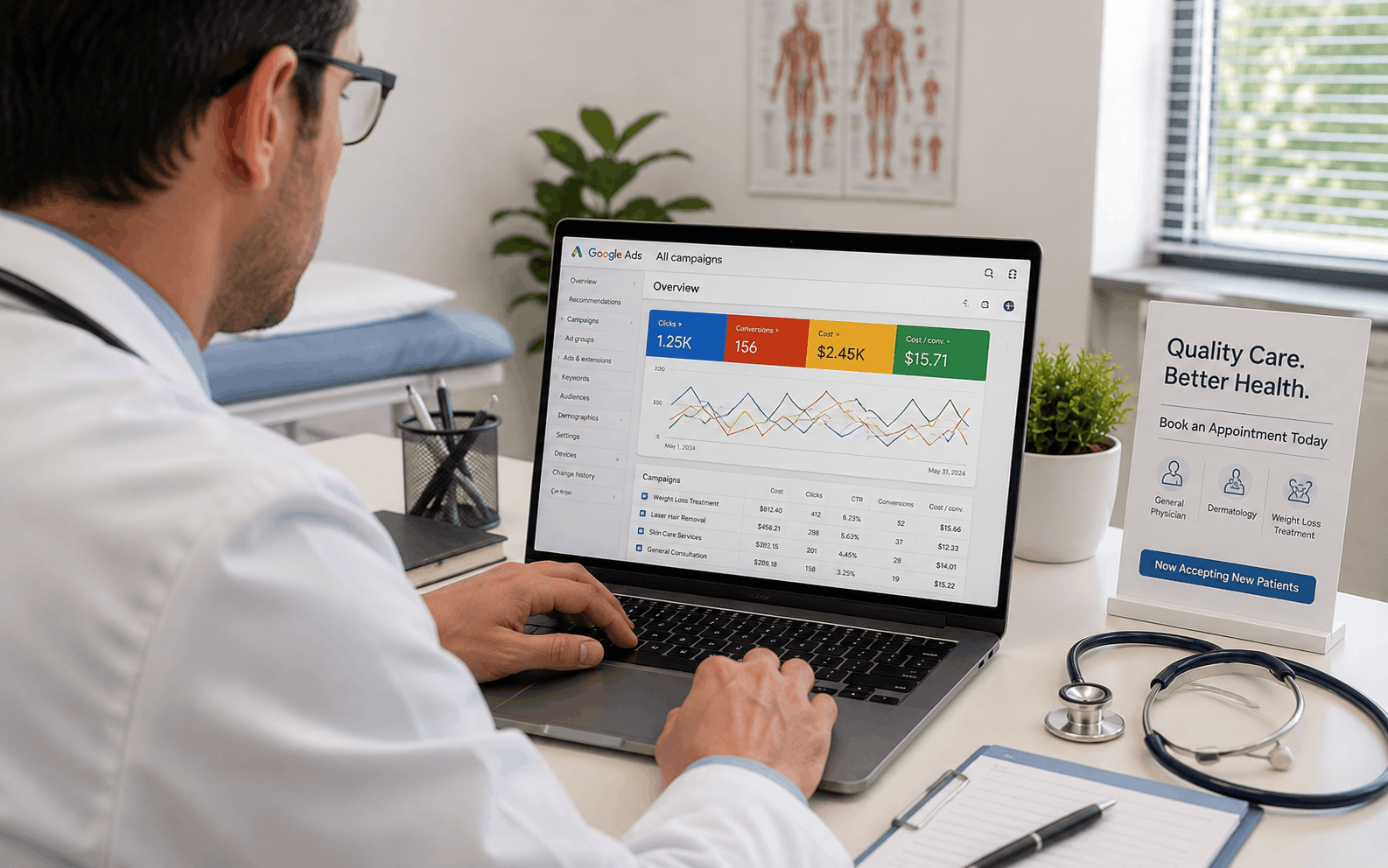
Quick answer: Google Ads for doctors combines paid search campaigns with SEO strategies to attract patients actively searching for medical services. When done correctly, the two channels reinforce each other: strong SEO lowers your ad costs, while Google Ads delivers immediate visibility while your organic rankings build. This guide covers both from the ground up.
Most doctors spend years building a reputation through referrals and word-of-mouth. But referrals alone don’t fill appointment books the way they once did. Patients now Google their symptoms before calling a doctor, compare providers before booking, and read reviews the way they used to ask friends for recommendations.
According to Google Health Vice President David Feinberg, approximately 7% of all Google searches are health-related, translating to over 1 billion healthcare searches every single day. That’s not a number you can afford to ignore.
Here’s the challenge: ranking organically in healthcare takes time, often three to six months before you see meaningful results. Google Ads, on the other hand, can put your practice at the top of search results within days. But running ads without an SEO foundation wastes money. Google rewards well-optimized websites with higher Quality Scores, which directly lowers your cost-per-click (CPC).
The smartest approach uses both. This post breaks down how to build a Google Ads and SEO strategy specifically for doctors, including keyword research, campaign structure, compliance requirements, content strategy, and common mistakes to avoid.
Why Google Ads and SEO Work Better Together for Medical Practices
It’s tempting to treat Google Ads and SEO as separate projects. In reality, they share the same foundation: keyword research, landing page quality, and user experience.
Google assigns every ad a Quality Score based on expected click-through rate, ad relevance, and landing page experience. A high Quality Score means lower CPC and better ad placement. A slow, outdated website with weak content drags that score down meaning you pay more for worse results.
SEO directly improves those Quality Score factors. When your landing pages load fast, match search intent, and feature credible, well-structured content, your ads perform better. Meanwhile, paid search data reveals which keywords actually convert patients, giving your SEO team better targeting information.
Neither channel is redundant. Google Ads give you instant visibility; SEO builds long-term authority.
How Google Classifies Medical Content and Why It Matters
Before spending a single dollar on ads or publishing a single blog post, doctors need to understand how Google treats healthcare content.
Google classifies medical websites under the YMYL category Your Money or Your Life. This label applies to content that can directly affect someone’s health, financial stability, or safety. Because the stakes are high, Google holds YMYL pages to a stricter standard using its E-E-A-T framework: Experience, Expertise, Authoritativeness, and Trustworthiness.
In practice, this means:
- Content should be written or reviewed by certified medical professionals
- Author credentials should be clearly displayed
- Your website should cite reputable sources
- Contact information, privacy policies, and credentials should be easily accessible
For Google Ads specifically, certain medical services require a Google Ads Health Certificate before campaigns can run. In the US, this applies to healthcare and pharmaceutical advertisers. Additionally, services like addiction treatment and online pharmacies require LegitScript certification. Running ads without proper certification results in disapprovals, reduced visibility, or account suspension.
HIPAA compliance adds another layer. Google Ads is not covered by Google’s Business Associate Agreement, which means Protected Health Information (PHI) must never appear in ad copy, form submissions, tracking tags, or retargeting audiences. Every aspect of your campaign setup from contact forms to analytics configurations needs to align with HIPAA guidelines.
Building Your Google Ads Keyword Strategy for Healthcare
Keyword selection is where most medical Google Ads campaigns succeed or fail.
The biggest mistake is targeting terms that are too broad. Bidding on “doctor” or “clinic” attracts a wide mix of search intent, most of which won’t convert. You’re paying for curiosity, not appointments.
What Keywords Should Doctors Target?
Think about how patients search when they’re ready to book. They’re not searching “how does the knee work.” They’re searching “knee pain specialist near me”.” These are transactional keyword queries from people who want to take action.
Effective keyword categories for medical Google Ads include:
- Condition-specific searches: “chronic back pain treatment,” “anxiety therapy near me”
- Procedure-specific searches: “minimally invasive sinus surgery,” “non-surgical knee pain relief”
- Location-based searches: “dermatologist in Austin,” “pediatric cardiologist New York”
- Long-tail keywords: “special needs pediatric clinic for children”.
Long-tail keywords have lower search volume but attract highly qualified leads. A parent searching for “special needs pediatric clinic for children with autism” is far more likely to book than someone searching “pediatric clinic.”
Keyword Match Types: Precision vs. Reach
Google Ads offers three match types that control when your ad appears:
- Broad Match: Your ad shows for loosely related searches, including synonyms. Wide reach, lower precision.
- Phrase Match: Your ad appears when the search contains your keyword phrase in order. Balanced reach and relevance.
- Exact Match: Your ad only triggers for very specific searches. Maximum control, lower volume.
For new campaigns focused on driving appointments, start with phrase and exact match. This keeps spend focused on relevant searches. As data accumulates, you can test broad match selectively.
Negative keywords are equally important. These prevent your ads from showing for irrelevant queries. For a medical practice, typical negatives include: “jobs,” “free clinic,” “clinical trial,” “DIY,” and educational terms like “how does [condition] work.” Without a strong negative keyword list, budget drains on searches that will never convert.
Campaign Structure That Keeps Spend Efficient
Google Ads follows a hierarchy: Account → Campaign → Ad Group → Ads and Keywords.
Keeping this structure organized is critical in healthcare, where services differ significantly in patient intent and cost per-click. A well structured campaign might look like:
Campaign: Mental Health Services
- Ad Group: Anxiety Treatment → keywords like “anxiety therapy near me”
- Ad Group: Teen Depression → keywords like “teen depression counseling”
- Ad Group: PTSD Counseling → keywords like “trauma therapy specialist”
Each ad group should have tightly related keywords and its own dedicated landing page. Mixing unrelated services into one ad group confuses Google’s algorithm, reduces Quality Scores, and drives up costs.
The SEO Foundation: What Needs to Be in Place Before Ads Run
Running Google Ads to a weak website is like pouring water into a leaking bucket. Before campaigns go live, the website itself needs to support conversion.
Local SEO for Medical Practices
Most patients search for doctors near them. Local SEO ensures your practice appears in those searches both in organic results and Google Maps.
Key local SEO steps:
- Set up and verify your Google Business Profile with an accurate name, address, and phone number (NAP)
- Maintain NAP consistency across all online directories
- Collect patient reviews consistently nearly 60% of patients Google for reviews, and 62% say positive reviews are a very important factor in choosing a provider (according to Tebra’s 5th Annual Patient Perspectives Report)
- Use location-specific keywords like “cardiologist in Manhattan” throughout your website content
Website Performance and Mobile Optimization
Over 60% of health-related searches happen on mobile devices. A website that loads slowly or displays poorly on phones costs you patients and ad dollars simultaneously.
Every additional second of page load time reduces conversions by up to 20%. Use Google PageSpeed Insights to identify performance issues image compression, unnecessary scripts, and server response times are common culprits.
Mobile-friendly design isn’t optional. Forms should be short and easy to complete on a small screen. Call-to-action buttons need to be prominent and thumb-sized. Appointment booking should require as few steps as possible.
Content Strategy: Helpful, Accurate, and Built for E-E-A-T
Publishing educational blog content symptoms, treatment explanations, wellness tips builds topical authority and improves organic rankings. But medical content must meet a high standard. Google penalizes inaccurate or thin healthcare content by pushing it well beyond the first page of results.
Practical content rules for medical SEO:
- Write or review content with a licensed professional
- Avoid medical jargon; prioritize plain language
- Cite reputable sources (medical associations, peer-reviewed research)
- Update content regularly as treatments and guidelines evolve
- Include clear author bios with credentials
A single-page website cannot rank for multiple services. Each specialty, condition, or procedure deserves its own dedicated page with targeted keywords, relevant content, and a clear call to action.
Writing Ad Copy and Landing Pages That Book Appointments
Your ad gets three seconds to capture attention. Your landing page has slightly longer but not much.
Responsive Search Ads for Doctors
Google’s Responsive Search Ads (RSAs) allow you to input multiple headlines and descriptions, which Google automatically tests in different combinations. More variations give the algorithm more to work with.
A strong RSA for a medical practice includes:
- 5 keyword-based headlines (e.g., “Chronic Back Pain Treatment”)
- 5 CTA headlines (e.g., “Book Your Consultation Today”)
- 5 benefit headlines (e.g., “Board-Certified Specialists Near You”)
Avoid guaranteed outcomes in ad copy. Phrases like “Guaranteed Pain Relief” violate Google Ads policies and can lead to suspension. Instead, focus on credentials, convenience, and patient-centered benefits.
Ad extensions add valuable detail without extra cost:
- Call extensions allow patients to call directly from the ad
- Location extensions link to Google Maps
- Sitelink extensions highlight specific services
- Callout extensions display short trust signals like “Same-Day Appointments” or “Accepting New Patients”
Landing Pages vs. Homepage: Why It Matters
Sending ad traffic to your homepage is one of the most common and costly mistakes in healthcare advertising. Homepages are general by design. Landing pages are built around a single action.
An effective medical landing page includes:
- A brief description of the service and its benefits
- A prominent appointment booking form near the top
- A clickable phone number
- Insurance information (patients cite this as a top decision factor)
- Patient testimonials or star ratings (HIPAA-compliant no identifiable information)
- A clear, repeated CTA throughout the page
If you run ads for multiple services, each service line should have its own landing page. Message consistency between the keyword, ad, and landing page is one of the most significant drivers of conversion.
Tracking Performance and Measuring ROI
Google estimates that Google Ads delivers an average 800% return on investment. But that figure assumes proper tracking is in place. Without accurate data, optimization becomes guesswork.
Key Metrics for Medical Google Ads
- Click-Through Rate (CTR): Percentage of people who click your ad after seeing it. A low CTR signals weak ad copy or poor keyword relevance.
- Conversion Rate: Percentage of clicks that result in a booked appointment or form submission. This is the metric that matters most.
- Cost Per Acquisition (CPA): What you spend to acquire one new patient through ads.
- Return on Investment (ROI): Revenue generated from new patients relative to total ad spend.
Set up conversion tracking using a thank-you page trigger a confirmation page that only loads after a form is completed. This prevents double-counting and keeps your data clean.
From a HIPAA perspective, configure Google Tag Manager carefully. No Protected Health Information should pass through tracking tags, variables, or third-party analytics tools.
Remarketing Patients Who Didn’t Book
Most visitors don’t convert on their first visit. Care Sherpa data found that 79% of leads never convert, partly because 23% of providers fail to respond to digital inquiries at all. Remarketing helps recapture lost interest.
Remarketing Lists for Search Ads (RLSA) let you show tailored ads to previous website visitors when they search again. Combined with follow-up email sequences for visitors who submitted contact forms, remarketing keeps your practice visible throughout the patient decision-making process.
Common SEO and Google Ads Mistakes Doctors Make
Even well-intentioned campaigns fail when these mistakes occur:
- Sending ad traffic to a general homepage instead of a service-specific landing page
- Skipping negative keywords, allowing budget to drain on irrelevant searches
- Ignoring mobile optimization, despite 60%+ of searches happening on phones
- Publishing a one-page website that limits keyword targeting and ranking opportunities
- Not collecting reviews actively, weakening both local SEO and conversion rates
- Running ads without HIPAA-compliant tracking, which creates legal exposure
- Setting budgets too low for competitive healthcare keywords, resulting in ads that rarely appear
Mid-market medical organizations should budget between 8–14% of total revenue for marketing. Underspending in a competitive local market means your ads show infrequently essentially paying for nothing.
Building a Strategy That Compounds Over Time
Google Ads and SEO are not one-time projects. Both require ongoing refinement.
For ads, a practical maintenance schedule looks like this:
- Weekly: Review search terms and add new negative keywords
- Bi-weekly: Adjust budgets based on campaign performance
- Monthly: Test new ad copy and review CTR trends
- Quarterly: Assess geographic targeting, review landing page conversion rates, and evaluate keyword list
For SEO, publish new content regularly, update existing pages as medical information evolves, and build backlinks from reputable health directories and medical associations.
The compounding effect is real. Organic rankings improve as your website gains authority, patient reviews accumulate, and content depth grows. That rising tide lowers paid search costs over time you gain better ad placement for less spend.
From Clicks to Patients: Making the Strategy Work
Running Google Ads without SEO is expensive. Running SEO without paid search is slow. Combining both gives medical practices the best of both worlds: immediate visibility while long-term authority builds.
Start by auditing your current website for speed, mobile optimization, and content accuracy. Set up your Google Business Profile and begin collecting reviews. Then build campaigns around condition-specific and location-based keywords, with dedicated landing pages for each service. Track every conversion, stay compliant with HIPAA guidelines, and refine based on data rather than assumptions.
The practices that win patient acquisition aren’t necessarily the largest or best-resourced they’re the ones that show up consistently, build trust through their digital presence, and make it easy for patients to take the next step.
Frequently Asked Questions
What is the difference between Google Ads and SEO for doctors?
Google Ads are paid placements that appear at the top of search results immediately after a campaign launches. SEO involves optimizing your website and content to rank organically over time. Ads deliver fast results; SEO builds lasting authority. Most successful medical practices use both, because SEO improves the Quality Score that determines how much Google Ads cost.
How much should a medical practice spend on Google Ads?
Budget depends on your market, specialty, and growth goals. Mid-market healthcare organizations typically invest 8–14% of total revenue in marketing. Healthcare keywords are competitive and often carry high cost-per-click rates, so underspending frequently results in ads that rarely appear. Research your local keyword costs before setting a budget.
Do doctors need a special certification to run Google Ads?
Yes. In the United States, healthcare advertisers must obtain a Google Ads Health Certificate before running certain medical service ads. Some services such as addiction treatment and online pharmacy advertising also require LegitScript certification. Running ads without proper certification can result in account-level restrictions or suspension.
How long does SEO take for a medical practice?
Typically, noticeable improvements appear within three to six months. The timeline depends on your website’s current state, local competition, and how consistently new content is published. Practices starting from scratch may take longer to see meaningful organic traffic.
What are the HIPAA rules that affect Google Ads for doctors?
Google Ads is not covered by Google’s Business Associate Agreement. This means healthcare advertisers must never include Protected Health Information in ad copy, form submissions, conversion tracking, or retargeting audiences. Use HIPAA-compliant tools for analytics and call tracking, and configure Google Tag Manager to avoid passing any sensitive health-related data to third parties.