How to Build a B2B SaaS Sales Operations Team That Scales
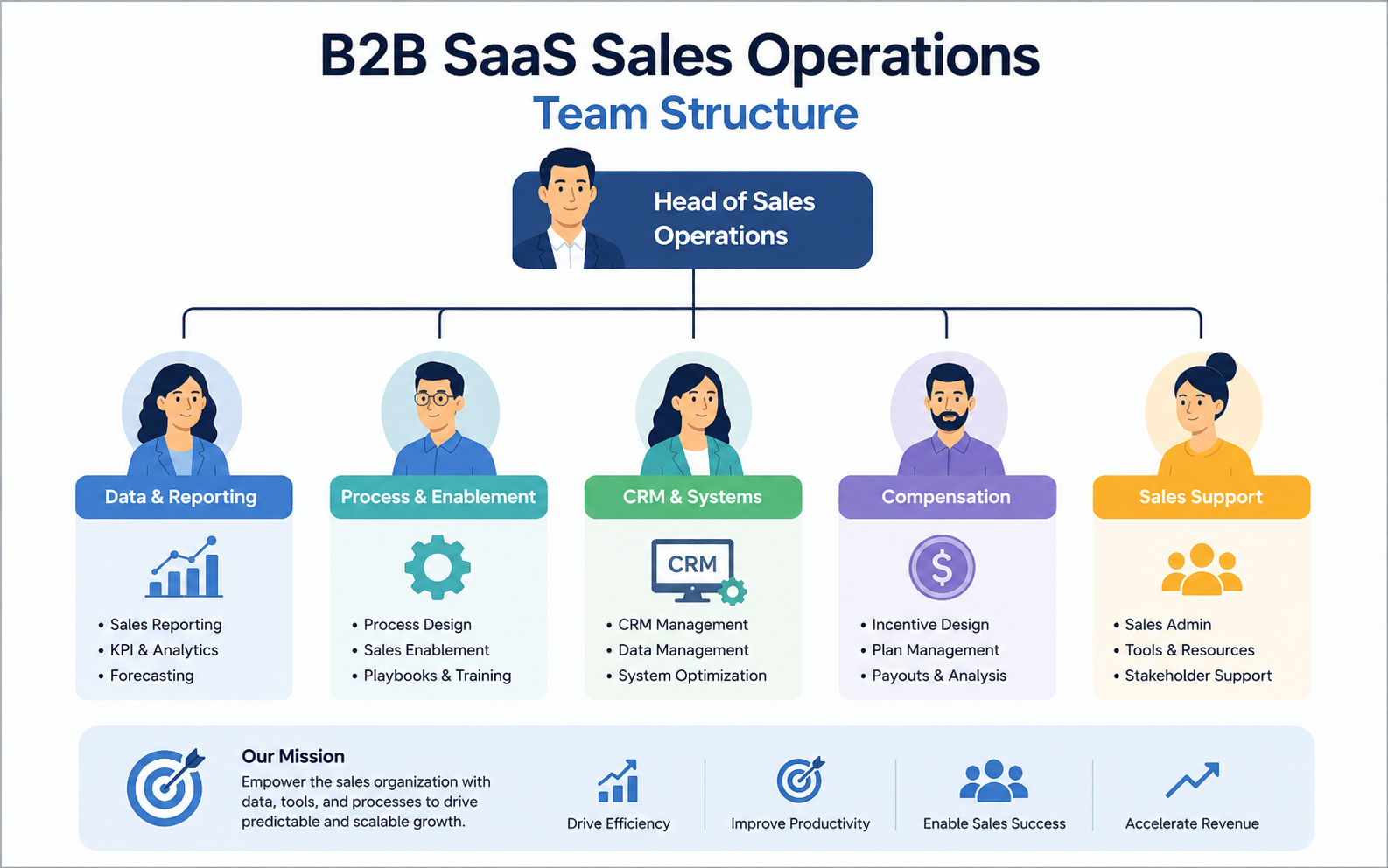
A strong B2B SaaS sales operations team structure usually includes a sales ops leader, analysts, tools and systems specialists, and process or enablement roles. Together, they manage data, automate workflows, and support reps so revenue teams can sell faster and smarter.
Building the right b2b saas sales operations team structure is one of the smartest moves a growing software company can make. As your sales team scales, manual processes break down, data gets messy, and reps spend more time on admin than on selling. A well-designed sales operations function fixes this. It brings order, speed, and clarity to how your revenue engine runs.
In this guide, you’ll learn what a sales operations team does, how to structure it at each stage of growth, and which roles matter most. We’ll also cover practical use cases, the role of automation and machine learning, and where this function is heading in the future. By the end, you’ll have a clear roadmap for designing a team that supports your reps and drives predictable revenue.
What Is a B2B SaaS Sales Operations Team?
A sales operations team is the group responsible for the systems, data, and processes behind your sales effort. Think of them as the engine room of your revenue organization. While reps focus on closing deals, sales ops makes sure everything around them works smoothly.
In a B2B SaaS company, this team handles things like CRM management, sales forecasting, territory planning, commission tracking, and reporting. They also own the tech stack—the collection of tools your sales team uses every day.
The b2b saas sales operations team structure varies based on company size. A startup might have one generalist wearing many hats. A larger company will have specialists for analytics, tools, and enablement. The goal stays the same: remove friction so reps can sell.
Why Sales Ops Matters More in SaaS
SaaS sales move fast and rely heavily on data. Subscription models mean revenue is recurring, so retention and expansion matter just as much as new deals. Sales operations tracks these metrics and turns them into insights leaders can act on.
Without a clear structure, even talented sales teams struggle. Deals slip through cracks. Forecasts become guesswork. A defined b2b saas sales operations team structure brings the discipline needed to grow without chaos.
Key Benefits of a Strong Sales Operations Structure
A well-built sales ops team delivers value across the entire revenue organization. Here are the main benefits.
Better forecasting accuracy. With clean data and clear processes, sales ops helps leaders predict revenue with confidence. According to research from analyst firms, companies with mature sales operations see measurably higher forecast accuracy.
More selling time for reps. When sales ops automates admin tasks, reps spend more hours actually selling. Less data entry, fewer manual reports, more conversations with buyers.
Faster decision-making. Real-time dashboards and reports give leaders the information they need quickly. No more waiting days for someone to pull numbers from a spreadsheet.
Smoother scaling. A clear b2b saas sales operations team structure makes growth easier. When you hire ten new reps, the systems and processes already exist to support them.
Aligned teams. Sales ops often sits between marketing, sales, and customer success. This position helps align goals, share data, and reduce finger-pointing across departments.
How a B2B SaaS Sales Operations Team Structure Works
The right structure depends on your company’s size and stage. Let’s break it down by growth phase, then look at the core roles.
Early Stage: The Generalist Model
In a startup with fewer than 20 reps, you likely need just one or two sales ops people. This person is a generalist who handles CRM setup, basic reporting, and process design. They wear many hats and solve problems as they appear.
At this stage, the focus is on building strong foundations. Clean data, a working CRM, and simple, repeatable processes matter most.
Growth Stage: The Specialist Model
As your team grows past 20 or 30 reps, one person can’t do it all. This is when you start adding specialists. A typical growth-stage b2b saas sales operations team structure includes:
- Sales Ops Manager or Director who leads the function and sets strategy
- Sales Analysts who handle forecasting, reporting, and data analysis
- Systems/Tools Specialists who manage the CRM and tech stack
- Sales Enablement roles that focus on training and content
Enterprise Stage: The Specialized Team
Large SaaS companies build deep, specialized teams. You might see dedicated roles for deal desk, territory planning, compensation, data engineering, and revenue operations. At this scale, sales ops often merges into a broader RevOps function that covers marketing, sales, and customer success operations.
Core Roles Explained
Here’s a closer look at the most common roles in a sales operations team.
Sales Operations Leader. This person owns strategy and connects sales ops to company goals. They report to the VP of Sales or Chief Revenue Officer.
Sales Analyst. Analysts live in the data. They build forecasts, track KPIs, and find insights that help leaders make smart calls. Increasingly, they use machine learning tools to spot patterns in large datasets.
Tools and Systems Admin. This role manages the CRM and the wider tech stack. They handle integrations, fix data issues, and roll out new tools.
Sales Enablement Specialist. Enablement focuses on the people side—training reps, building playbooks, and making sure the team knows how to use its tools.
Real-World Use Cases for Sales Operations
To see why structure matters, look at how sales ops shows up in daily work.
CRM cleanup and automation. A messy CRM slows everyone down. Sales ops cleans the data, sets up automation rules, and builds workflows that move deals forward without manual effort.
Lead routing. When a new lead comes in, who gets it? Sales ops designs the rules that send each lead to the right rep based on territory, industry, or deal size.
Commission and quota planning. Sales ops models out quotas and builds fair, motivating commission plans. They also track attainment, so reps and leaders always know where they stand.
Sales forecasting. Using historical data and pipeline trends, sales ops builds forecasts leaders trust. AI and automation now make these forecasts faster and more accurate.
Tech stack management. From the CRM to sales engagement tools, sales ops decides what to buy, how to set it up, and whether it’s worth the cost.
SEO and Content Tips for Sales Ops Teams
Sales operations don’t work in a silo. The same data-driven mindset that powers sales ops can sharpen your marketing and content strategy. Here are a few ways the two connect.
Use sales data to guide content. Your sales team hears real objections and questions every day. Feed these insights into your content plan so your blog and resources answer what buyers actually ask.
Apply an agile SEO approach. Just as agile sales ops tests and improves processes in short cycles, agile SEO means testing keywords, updating pages, and measuring results often. Small, frequent improvements beat big, rare overhauls.
Lean into AI SEO tools. AI SEO platforms help you find keyword gaps, optimize pages, and scale content faster. Sales ops teams that share data with marketing make these tools even more powerful.
Track the full funnel. Sales ops can connect marketing-sourced leads to closed revenue. This data shows which content and keywords drive real pipeline, not just clicks.
The Future of B2B SaaS Sales Operations
The role of sales operations is changing fast, and automation sits at the center of that shift.
AI and machine learning will do more. Routine tasks like data entry, lead scoring, and basic forecasting are moving to AI. This frees sales ops people to focus on strategy and complex problems. Machine learning models can now predict which deals will close and flag at-risk accounts early.
RevOps will keep rising. More companies are merging sales, marketing, and customer success operations into one revenue operations team. This breaks down silos and gives leaders a single source of truth.
Automation becomes the norm. From automated workflows to smart alerts, automation is no longer optional. The best sales ops teams build systems that run themselves, stepping in only when something needs a human touch.
Data skills become essential. As tools get smarter, sales ops people need stronger data skills. Knowing how to read, clean, and interpret data is now a core requirement, not a nice-to-have.
Teams that embrace these shifts will build a b2b saas sales operations team structure ready for the next decade. Those that don’t risk falling behind.
Final Thoughts on Building Your Sales Ops Team
A thoughtful b2b saas sales operations team structure is the backbone of any scaling software company. It keeps your data clean, your reps focused, and your forecasts accurate. Whether you start with one generalist or build a full RevOps team, the goal stays the same: remove friction and drive predictable growth.
Start small and grow with intent. Build strong foundations first—a clean CRM, clear processes, and good data. Then add specialists as your team scales. Lean into automation, AI, and machine learning to do more with less. And keep your sales ops connected to marketing and customer success so the whole revenue engine runs as one.
Get the structure right, and your sales team won’t just hit targets. They’ll beat them, year after year.
Frequently Asked Questions
What does a B2B SaaS sales operations team do?
A B2B SaaS sales operations team manages the systems, data, and processes behind selling. This includes CRM management, forecasting, lead routing, commission planning, and tech stack management. Their job is to remove friction so sales reps can focus on closing deals.
When should a SaaS startup hire its first sales ops person?
Most SaaS startups hire their first dedicated sales ops person when they reach around 10 to 20 reps. Before that, founders or sales leaders often handle these tasks. Once manual processes start slowing the team down, it’s time to bring in a specialist.
What is the difference between sales ops and RevOps?
Sales operations focuses specifically on the sales team’s systems and processes. Revenue operations (RevOps) is broader—it combines sales, marketing, and customer success operations into one unified team. Many growing companies evolve from sales ops into a full RevOps structure.
How big should a sales operations team be?
The size depends on your company’s stage. Early-stage startups may have one generalist. Growth-stage companies often run a team of three to six specialists. Enterprise SaaS companies can have large, specialized teams or a broad RevOps function with dozens of people.
What tools does a sales operations team use?
A sales operations team relies on a CRM as its core tool, plus sales engagement platforms, analytics and BI software, forecasting tools, and increasingly AI and machine learning solutions for automation and predictive insights.