SaaS Product Development – A Complete Guide for Startups and Businesses
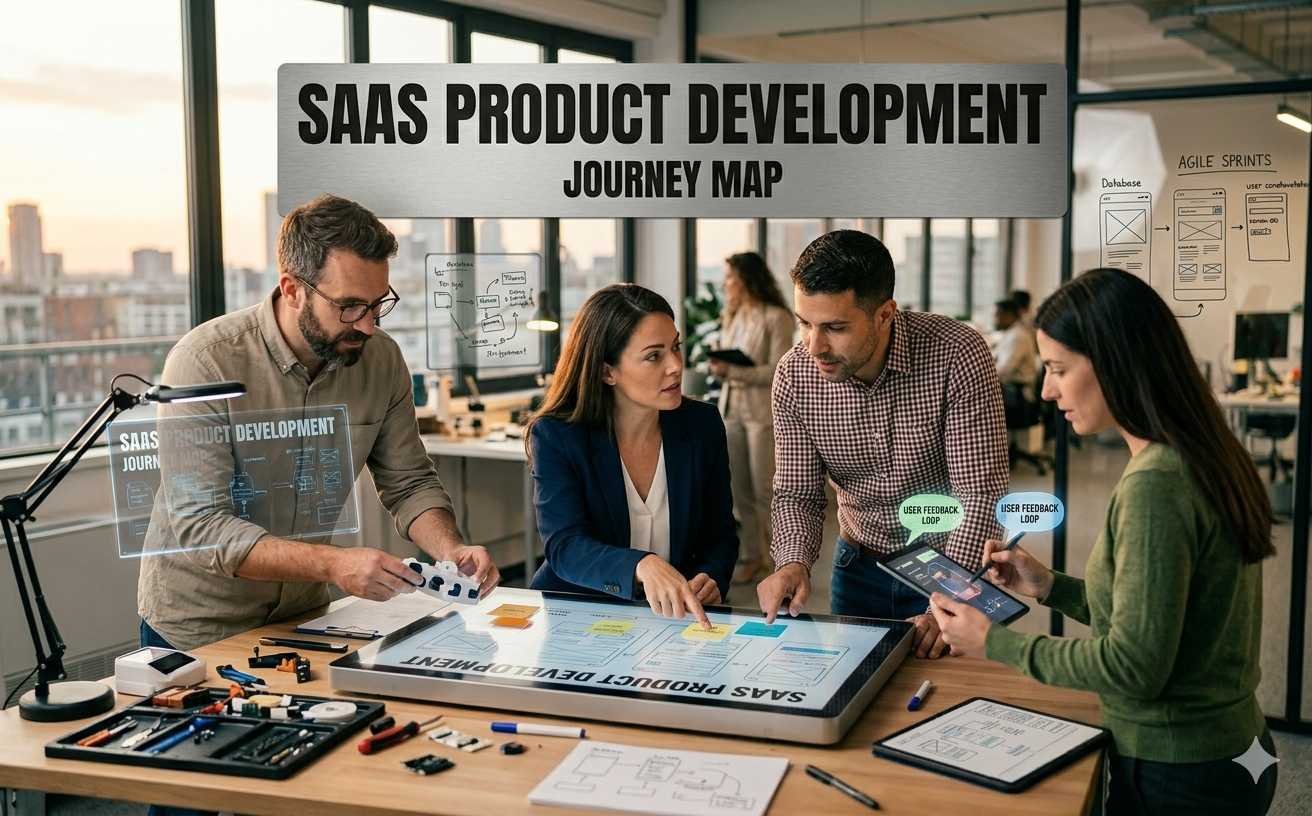
SaaS product development is the process of building, hosting, and maintaining software delivered over the internet via a subscription. Successful development requires identifying a target audience, creating a strategic product roadmap, building a Minimum Viable Product (MVP), choosing a scalable multi-tenant architecture, and using agile methodologies to iterate based on user feedback.
Building a software business from scratch is a massive undertaking. Many founders assume that writing the code is the hardest part. However, writing code is just one small piece of a much larger puzzle. To build a product that customers actually want to pay for month after month, you need a strategic approach to software creation.
This is where understanding SaaS product development becomes your competitive advantage. Whether you are an early-stage startup looking to disrupt an industry or an established business moving into the digital space, the way you build your product dictates your future success.
By approaching the build strategically, you can avoid costly rebuilds and get your solution into the hands of paying customers faster. This guide covers everything business owners need to know about taking a cloud-based software concept from an initial idea to a profitable reality.
What is software as a service, and why does it matter?
Software as a service (SaaS) is a delivery model where applications are hosted by a vendor or service provider and made available to customers over a network, typically the internet. Instead of installing software on local servers or hard drives, users access the platform via a web browser.
The primary advantage of this model is the recurring revenue stream it generates. Because customers pay a weekly, monthly, or annual fee, your business can build a predictable financial model. [Link to internal page: Understanding SaaS Revenue Models]
Additionally, this approach provides massive scalability. When you host the application in the cloud, you can seamlessly onboard ten users or ten thousand users without needing to ship physical products or conduct manual installations. The provider manages all updates and security patches, meaning every customer always has the most up-to-date version of the platform.
For startups, entering the SaaS market offers high profit margins once the initial development costs are recovered. However, reaching that point of profitability requires a disciplined execution of the core development phases.
What are the key stages in the SaaS development process?
Every successful application follows a structured lifecycle. Rushing directly into coding often leads to feature bloat and wasted capital. To avoid these common pitfalls, follow this proven SaaS development process.
Market research and defining the product roadmap
Before writing a single line of code, you must validate that the market actually needs your solution. Start by conducting customer interviews, analyzing competitors, and defining your unique value proposition.
Once you have validated the core problem, you need to create a product roadmap. A product roadmap acts as a strategic blueprint that outlines the vision, direction, and progress of the software over time. It helps align your development team with your business goals. [Link to internal page: How to Build a Product Roadmap]
Building the Minimum Viable Product (MVP)
A Minimum Viable Product (MVP) is the most stripped-down version of your software that still solves the core problem for your target audience. You should aim to release an MVP as quickly as possible.
The goal of an MVP is not to launch a perfect product, but to gather actual user feedback from early adopters. If your users require advanced reporting features before they will pay for the software, you want to learn that within three months, not twelve.
Choosing the right SaaS architecture
Your underlying technology choices dictate how well your platform will scale. Most modern cloud-based software relies on a multi-tenant architecture. Multi-tenancy means that a single instance of the software and its supporting infrastructure serves multiple customers (tenants).
If you need strict data isolation for enterprise clients (like healthcare or finance organizations), you might choose a single-tenant architecture. However, choose multi-tenant architecture if scalability and lower infrastructure costs matter more than deep, individual customization. You must also decide between cloud providers like AWS, Google Cloud, or Microsoft Azure based on your team’s technical expertise.
Development, testing, and launch
With the architecture in place, the coding phase begins. Developers will build the front-end user interface and the back-end database systems.
Quality assurance testing is critical here. If the initial version is plagued with bugs, users will churn quickly. Once the application passes strict security and usability tests, it moves into the deployment phase for public launch.
How do you choose the best subscription model for your cloud-based software?
Your pricing strategy directly influences your SaaS product development cycle because the software must be built to restrict or grant access based on payments. Implementing the right subscription model from day one prevents major billing headaches later.
Most platforms start with a flat-rate pricing tier, offering all features for a single monthly price. While simple, this often leaves money on the table. A better approach for many B2B applications is a tiered pricing strategy, where customers pay more to unlock advanced features or higher usage limits.
Alternatively, you can offer a usage-based or “pay-as-you-go” model. This charges users based on how much data they consume or how many transactions they process. [Link to internal page: Best Billing Software for SaaS Startups]
Your development team will need to integrate a secure payment gateway, such as Stripe or Braintree, to automate recurring billing, handle failed payments, and manage subscription upgrades smoothly.
Why is agile development critical for SaaS growth?
The software market moves fast. If you spend two years building a product in secret, the market may shift before you ever launch. This is why agile development is the industry standard for software creation.
Agile methodology breaks the development work into small, manageable phases known as sprints. Instead of waiting months for a massive update, developers push small improvements, new features, and bug fixes to the live environment every few weeks.
This iterative cycle ensures that your SaaS product development efforts are always aligned with user feedback. When customers request a specific integration, an agile team can pivot quickly and prioritize that feature in the next sprint, increasing customer satisfaction and reducing churn.
Navigating the future of your SaaS product development
Building a profitable cloud software company requires patience, capital, and the right technical expertise. From defining your roadmap to engineering a scalable cloud infrastructure, every decision impacts the user experience and your bottom line.
By focusing on a strong MVP, prioritizing user feedback, and maintaining an agile approach to feature updates, you drastically increase your chances of long-term success. The technology landscape will continue to evolve, but platforms built on solid, scalable foundations will always win out over poorly planned alternatives.
If you are ready to turn your software idea into a fully functioning, revenue-generating platform, you do not have to do it alone. Reach out to our team of development experts today to discuss your vision and get a personalized project estimate. [Link to internal page: Contact Us for Development Services]
Frequently Asked Questions (FAQ)
How long does SaaS product development usually take?
Building a Minimum Viable Product (MVP) typically takes between 3 to 6 months, depending on the complexity of the features and the size of the development team. Full-scale platforms with advanced integrations and enterprise-grade security can take a year or more to fully develop.
What is the difference between single-tenant and multi-tenant SaaS architecture?
In a multi-tenant architecture, multiple customers share the same database and software instance, which reduces hosting costs and simplifies updates. In a single-tenant architecture, each customer gets their own independent database and software instance, which is more expensive but offers greater data privacy for highly regulated industries.
How much does it cost to build a SaaS application?
Development costs vary wildly based on the location of your development team, the required features, and the underlying technology stack. A basic MVP can cost between $25,000 and $50,000, while a complex enterprise application can easily exceed $150,000.
Why do I need a product roadmap for my SaaS business?
A product roadmap prevents scope creep by clearly defining what features are essential for launch and which ones can wait for later updates. It provides a visual guide for developers, investors, and stakeholders, ensuring everyone is working toward the same immediate business goals.